
Analysis & Decompilation
Interactive Decompiler
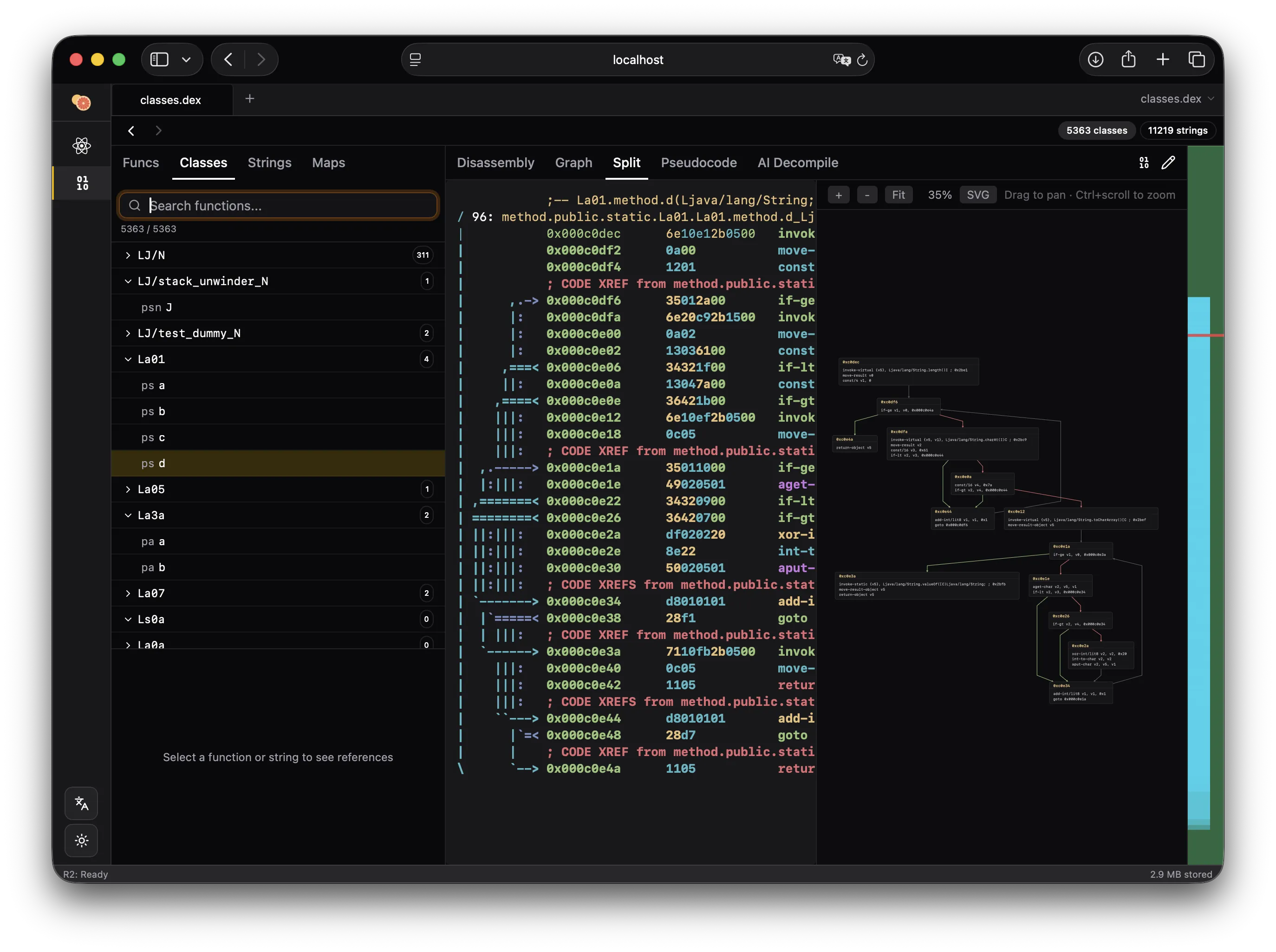
Grapefruit includes a fully browser-based decompiler powered by radare2 compiled to WebAssembly. Drop any binary file — ELF, Mach-O, DEX, or Hermes bytecode — and start reversing immediately. No device connection, no server-side processing, no setup.
The split view shows disassembly alongside a control flow graph. Switch between linear, graph, decompiler, and AI decompile modes. Browse functions, classes, strings, and cross-references in an integrated workspace.
Live Disassembly
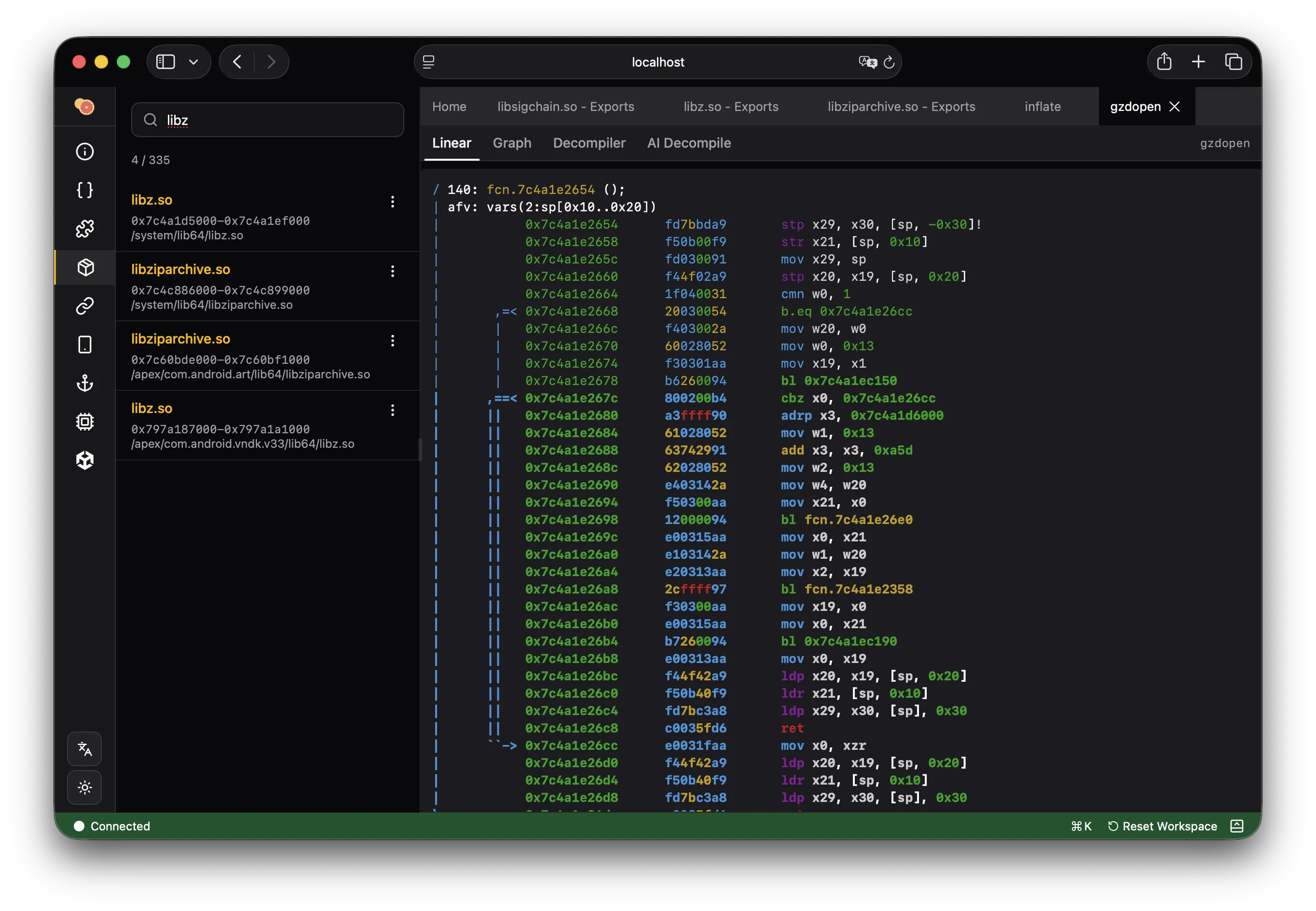
For live processes, memory is read on demand from the target device. Tap a function address in the module or class browser to open it in a disassembly tab with four views:
- Linear — Full function disassembly with syntax highlighting
- Graph — Control flow graph with basic blocks and jump/fail edges
- Decompiler — radare2's built-in pseudo-C decompiler output
- AI Decompile — Sends the disassembly to an LLM for high-quality C/C++ reconstruction with streaming output
The Graph view renders control flow with basic blocks and edges, color-coded by branch direction (green for true, red for false, gray for unconditional).
DEX Analysis
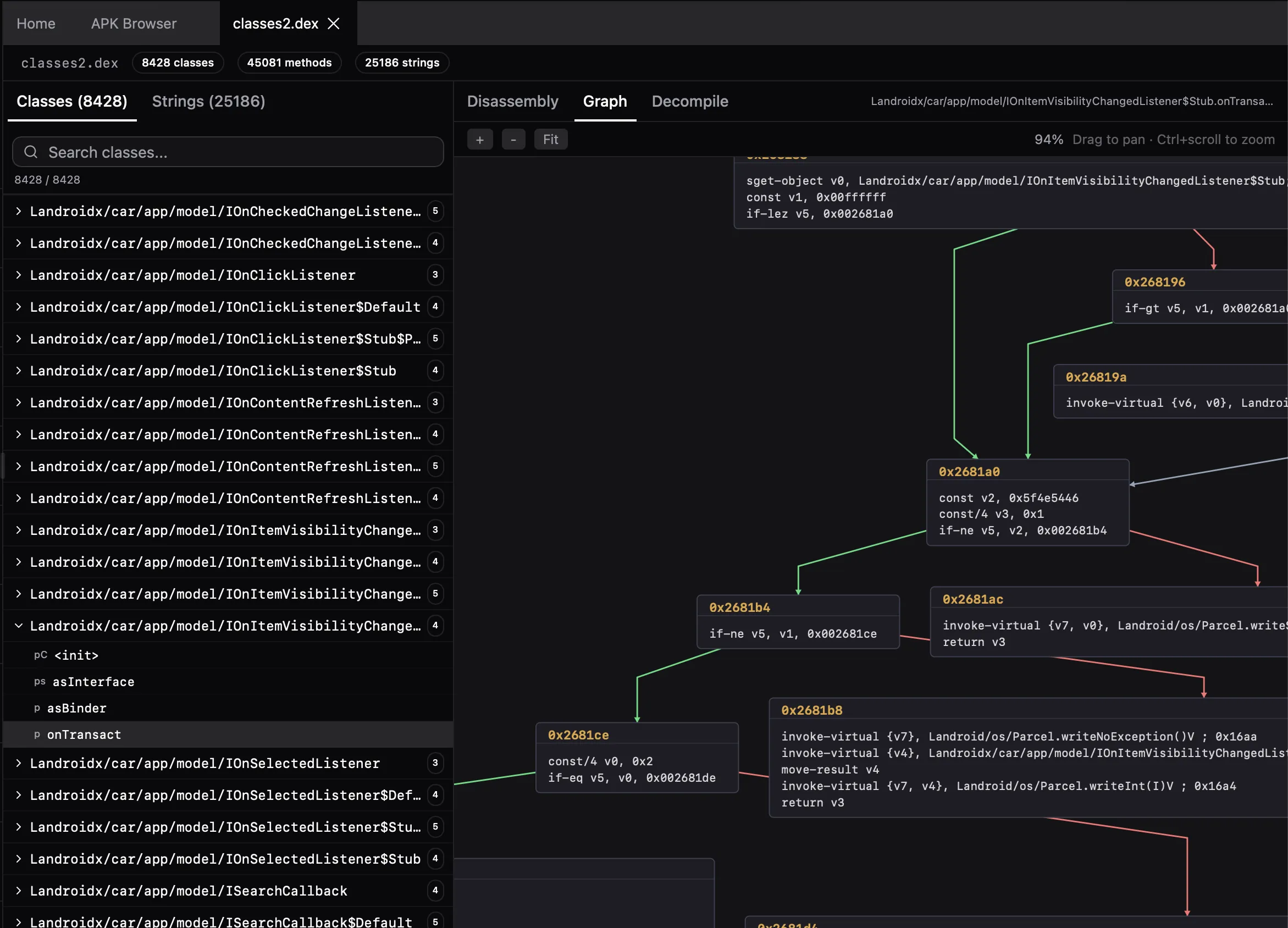
Open any .dex file from the APK browser or file system. Grapefruit fetches the file server-side and loads it into a radare2 session.
- Class browser — Lists all classes from
icoutput. Expand a class to see its methods and fields. Search by class name. - Method disassembly — Click a method to view its Dalvik bytecode. radare2 handles all instruction decoding natively.
- String search — Browse all strings in the DEX file. Click a string to find cross-references (which methods use it).
- Cross-references — Click an xref to jump directly to the referencing method's disassembly.
- AI Decompile — Decompile Dalvik bytecode to Java using an LLM.
Hermes Bytecode Analysis
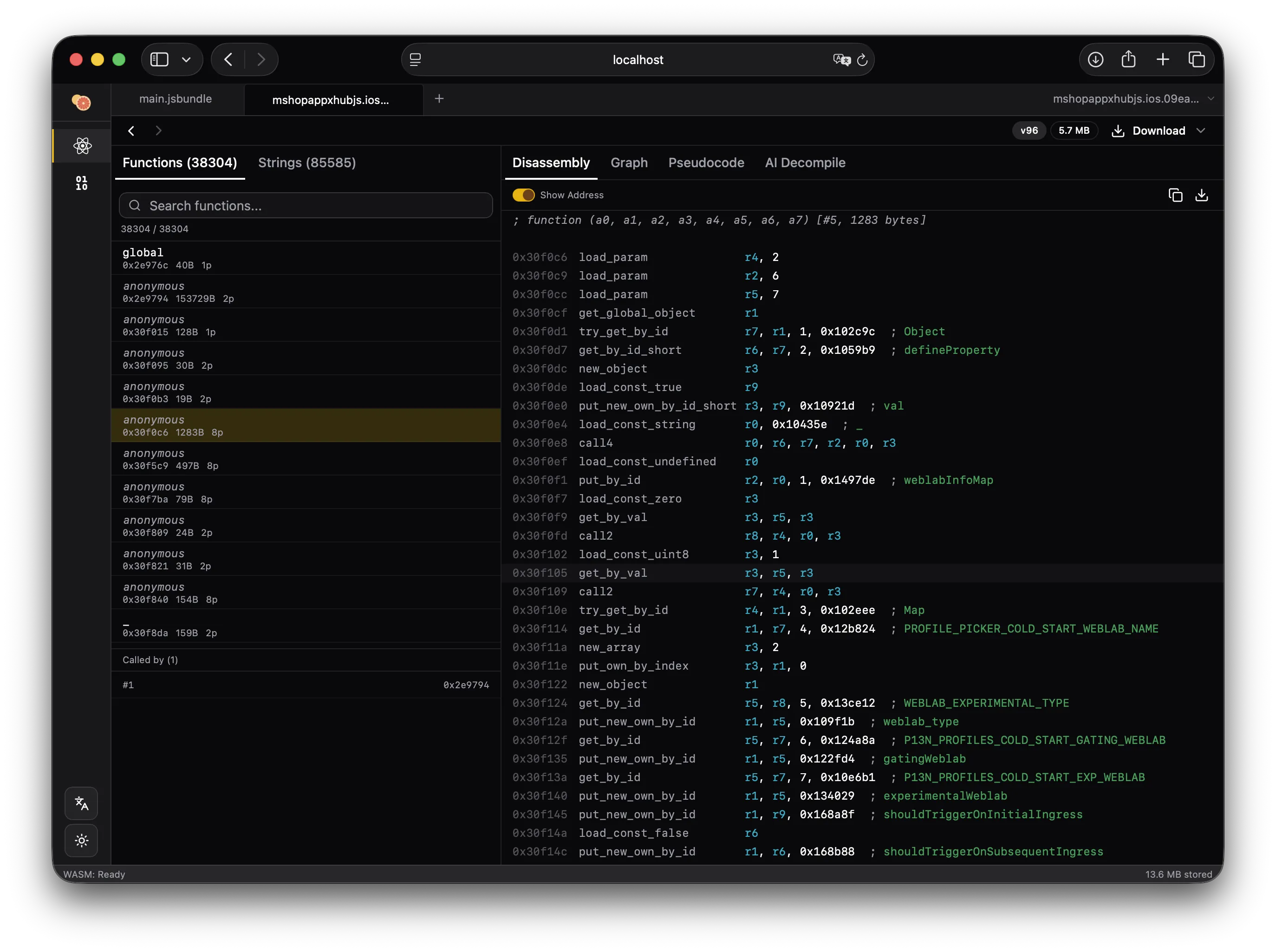
React Native apps using the Hermes engine compile JavaScript to proprietary bytecode. Grapefruit intercepts Hermes bytecode blobs at runtime and provides:
- Disassembly — Raw Hermes bytecode listing with function headers showing name, parameter count, and size
- Pseudocode — Rule-based decompilation from r2hermes that reconstructs JavaScript-like syntax from bytecodes
- AI Decompile — Sends both pseudocode and disassembly to an LLM to reconstruct idiomatic JavaScript with proper variable names, React/RN patterns, and simplified control flow
AI Decompilation
All three analysis modes (native, DEX, Hermes) support AI-powered decompilation. Configure the LLM provider with environment variables:
LLM_PROVIDER=anthropic   # or openai, gemini, openrouter
LLM_API_KEY=sk-...
LLM_MODEL=claude-sonnet-4-20250514
Before submission, disassembly is stripped of decorative formatting to reduce token usage and latency. Function names and parameter counts from the symbol table are included for better context.